
Interview With Kali Cawthon-Freels
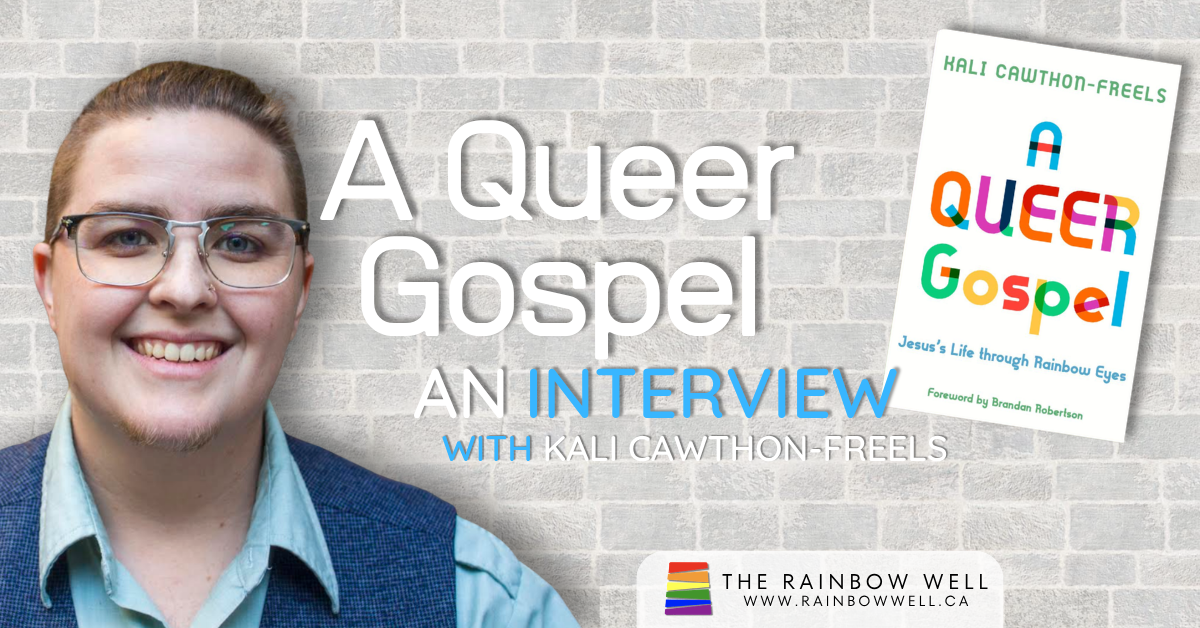
A Queer Gospel: Jesus’s Life through Rainbow Eyes reads the life, death, and resurrection of Jesus through a queer lens, not simply to argue that queer people can see themselves in Jesus, but to make the case that Jesus himself is queer: provocative, boundary-crossing, unwilling to conform to the social norms of his time. Drawing on queer theology, drag performance as a lens for understanding the incarnation, and the daily resurrections of trans and nonbinary people who choose to live as themselves, the book offers both a scholarly and pastoral reclamation of Jesus for those who have been told he has no room for them.
Rev. Kali Cawthon-Freels (she/her) is a bivocational pastor and writer based in Williamsburg, Virginia. She serves as director of the Faithful Pride Initiative at Good Faith Media and as Associate Pastor at Williamsburg Baptist Church. She is also the author of Reclamation: A Queer Pastor’s Guide to Finding Spiritual Growth in the Passages Used to Harm Us (Nurturing Faith Books). When she’s not pastoring or writing, she enjoys cooking and playing nerdy board games with her wife.
In this interview, I talk to Kali about what led her to read Jesus’s story through a queer lens, what the church misses when it fails to listen to queer voices, and what she hopes the book offers both to readers still finding their way back to Christianity and to those who have been too deeply harmed to want it back.
* * *
Jamie Arpin-Ricci: What first led you to read the life of Jesus through a queer lens, and why do you go beyond saying that queer people can see themselves in Jesus to saying that Jesus is queer?
Kali Cawthon-Freels: If we’re being honest with ourselves, there are many things about Jesus’s personhood, life, and ministry that are weird and often poorly explained by mainstream Christianity. Queerness offers a way to explain some of those otherwise poorly explained things. For example, the idea of Jesus being 100% man and 100% God only makes sense from a nonbinary perspective. Drag offers us a way to understand the incarnation that honors the distinct identities of God and Jesus (the same way that a drag performer’s persona is distinct from their day-to-day identity). In an almost ironic sense, queerness provides clarity.
Concerning the second part of the question, to me, Jesus is queer. He was provocative. He didn’t ascribe to the social norms of his time; in fact, he subverted many of them. It wasn’t necessarily about going beyond the idea that queer people can see themselves in Jesus so much as it was about highlighting a truth too many people overlook in order to fit Jesus into their own worldview.
JAR: Which part of the book most changed your own understanding of Jesus as you were writing it?
KCF: Engaging with Jesus’s story in this way was a poignant reminder of his humanity. Having spent my teens and early twenties in evangelical charismatic spaces, it was easy to over-emphasize the supernatural nature of Jesus’s miracles and personhood. He was a glorified superhero, impervious to harm.
After writing this book, I find myself thinking much more about what Jesus’s internal life might have been like—his emotions, doubts, even questions. I wonder about how he navigated emotional harm and anxiety. He’s become much more human to me because of this project, and that’s increased the spiritual intimacy with him in my own spirituality.
JAR: Queer Christians are often treated as people the church needs to debate, explain, or make room for. What does the church miss when it fails to recognize that queer people may have something important to teach it about Jesus?
KCF: The Church misses Jesus—plain and simple. If we believe that everyone carries the imago dei within them, but we continually exclude people we believe are too different, too radical, too “much,” then the image of God in our context will always be a fractured, incomplete image. If Jesus only ever looks like them, then they aren’t looking at Jesus; they’re looking in a mirror.
JAR: You connect the crucifixion of Jesus with the violence experienced by queer and trans people. What does that connection help us see about the cross and resurrection that we might otherwise miss?
KCF: People with marginalized identities often more easily feel resonance with the crucifixion by nature of the oppression we experience daily. One of the best examples of this is James Cone’s classic work The Cross and the Lynching Tree.
What engaging the cross and resurrection from a queer perspective does is remind us that resurrection is something we experience daily. Every day, trans and nonbinary people choose to present themselves to the world as themselves, despite how the world thinks they should show up. That is resurrection.
To clarify, I’m not suggesting that trans folks who prioritize safety over authenticity are minimizing their own capacity for resurrection. The fact that they have to even consider their bodily safety over an article of clothing is a symptom of just how hateful our society is. Choosing to live when the world wishes you were gone is its own, powerful kind of resurrection. It mirrors the stubbornness and grit Jesus demonstrated through his own refusal to stay dead.
JAR: Your book may help some queer people reclaim Jesus and Christianity, but others have been harmed too deeply to want either of them back. What would you say to those readers?
KCF: That’s okay.
The harm you experienced from the Church is terrible and inexcusable; I’m sorry that pain is part of your story. It is okay if you don’t want to engage Christianity. I would encourage you to find spiritual grounding and nourishment where and how it is safe and holds space for the whole of who you are. Your spiritual care is important, even if it doesn’t look like what others in your life say it “should” look like.
It was important for me to hold onto Jesus because there’s just something so compelling about his story that I can’t let go of it. But I recognize that’s just me and my story, not yours. I hope you find what gives you peace and healing.
JAR: Which books have been most important in shaping your thinking on these questions?
KCF: How many am I allowed to name?
A major goal of mine for this book was to make aspects of queer theology not only accessible for a lay audience, but practical to their daily spiritual lives. To that end, I read books by Patrick Cheng, Marcella Althaeus-Reid, Robert E. Shore-Goss, and others who regularly engage in and contribute to the field of queer theology. Purely from a scriptural perspective, I can’t recommend the Queer Bible Commentary enough. Every preacher should have a copy on their shelf.
The other, equally important goal was to provide ways for queer folks to see themselves in Jesus’s story. To that end, I read countless collections of stories, memoirs, and news articles about not only LGBTQ+ people’s experiences in the Church, but in the world. Their Own Receive Them Not by Horace L. Griffin, Christianity, LGBTQ Suicide, and the Souls of Queer Folk by Cody J. Sanders, Unnatural by Rachel Murr, and Our Witness edited by Brandan Robertson were especially helpful in finding people’s stories.
JAR: Are you working on any future books or other projects?
KCF: In addition to pastoring, I lead the Faithful Pride Initiative at Good Faith Media. Through FPI, we aim to accomplish two things: 1. Elevate the work of queer people of faith and 2. Create resources for their flourishing. In keeping with Goal #2, we are currently working on a multi-media resource for churches who hire or receive queer clergy for the first time. Part of the resource is a book containing contributions from LGBTQ+ clergy across different denominations addressing questions like, “What assumptions in our bylaws exclude the needs of queer clergy staff?”, “Does our health insurance plan provide coverage for things like gender-affirming care (surgery, hormones, etc.)?,” and “What conversations has our congregation had about LGBTQ+ inclusion, who has led them, and are they currently listening to LGBTQ+ voices?” among other, necessary questions. While I’m acting mostly as a general editor for this book, I also contributed a chapter. We sent the manuscript to our publisher last month.
The second part of that resource is a four-episode supplemental podcast that follows the journey of a congregation and their own LGBTQ+ clergy as they have navigated challenges to make their church a hospitable, supportive place for their clergy to serve while also engaging in public LGBTQ+ advocacy over the last decade or so. The church we’re profiling for the podcast is Oak Lawn UMC in Dallas, TX. The grant was awarded to us from the E. Rhodes and Leona B. Carpenter Foundation.
In terms of my own writing, I share pieces (mostly) weekly on my Substack Queer Faith and I contribute columns to GFM bi-monthly. I don’t currently have a plan for a next book (mostly because the majority of my current creative energy is focused on bringing A Queer Gospel into the world well), but I am certainly open to the muse bringing another idea to me.
JAR: Is there anything else about the book that you would like readers to know?
KCF: I’m a pastor at heart. My core motivation for pastoring is helping people know and understand their belovedness as a child of God. My work in this book is borne from that same motivation. I hope it heals something in you. I hope it revives something in you. I hope it helps you know and better understand your belovedness.
JAR: Thanks, Kali!
* * *
Kali’s words remind us that reclaiming Jesus is not the only faithful response to religious harm, and that no one is obligated to want either Jesus or the Church back. For those still working out where faith and identity meet, A Queer Gospel offers a way of seeing Jesus that doesn’t ask queer people to shrink themselves to fit him, and a reminder that resurrection is something many are already living out, one day at a time.